Introduction to Depreciation
Depreciation is a basic term in accounting; it is the decline in value of asset over the time. Items like machinery, vehicles, furniture, and equipment depreciate in value from using them, wear and tear, or obsolescence.
So for students who are searching about Accounting institute near me or Best accounting institute near me, depreciation is one of the major topics that they need to have knowledge about so that they can have a strong base in the field of accounting.
Why Depreciation Is Important
Depreciation allows businesses to reflect their assets more accurately on their respective financial statements. Rather than taking the total cost of an asset in one year, depreciation spreads that cost out over the life of the asset.
This matches expenses with revenue and gives an accurate reflection of profitability.
Causes of Depreciation
There are a number of reasons that assets depreciate with time. This can be due to physical wear and tear, one of the most common culprits. Been using it regularly, assets do lose their efficiency and effectiveness.
This could refer to technology that could make existing technology obsolete. Also, passage of time and environmental factors affect depreciation.
Types of Depreciation Methods
Straight Line Method
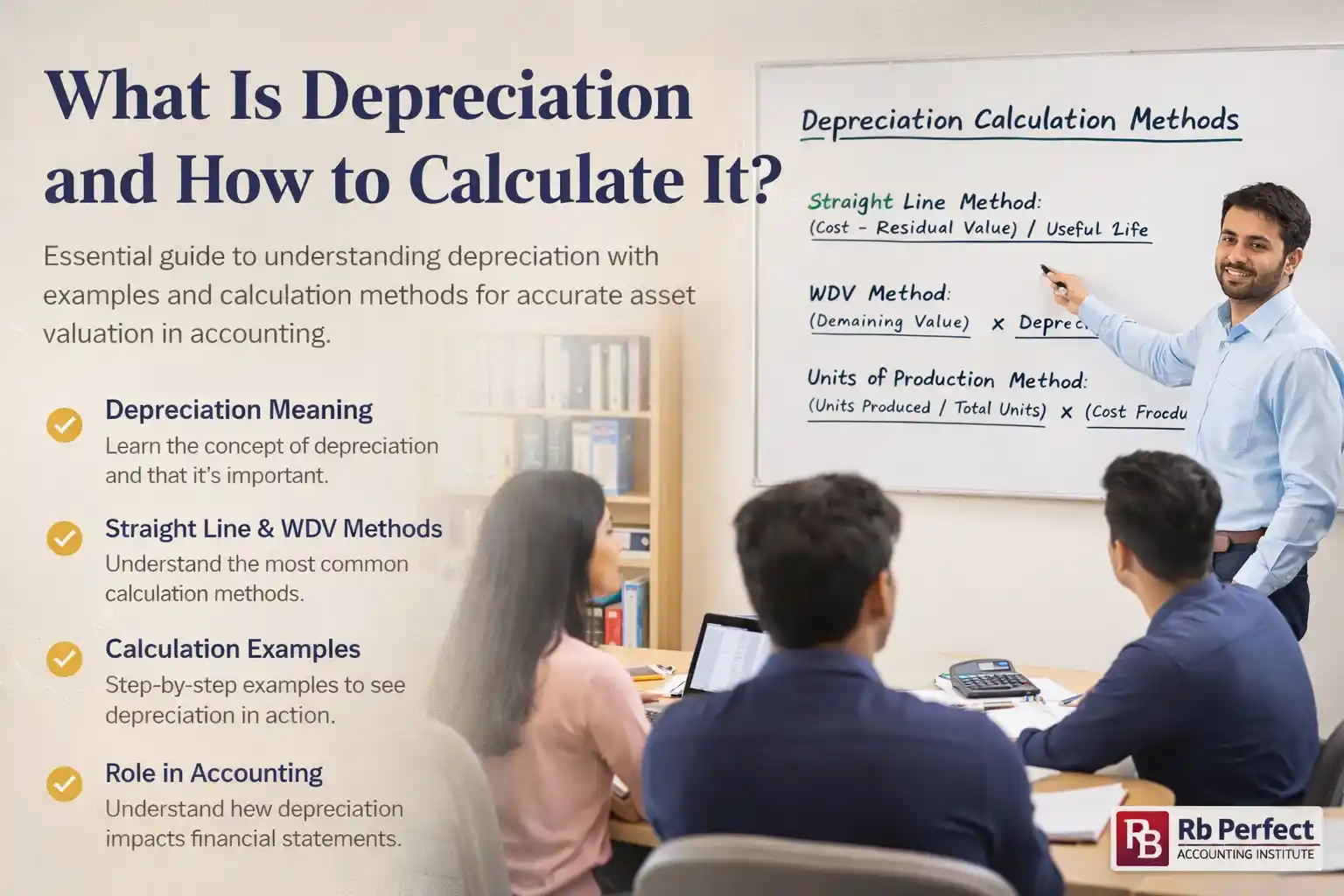
The straight line method: This is the simplest and most commonly used method. Under this method, asset depreciates the same amount each year over its useful life.
It is a simple logic that is utilized in practice.
Written Down Value Method
This is also called the reducing balance method, because depreciation is worked out on the book value of the asset each year.
Consequently, the depreciation expense declines over the years.
Units of Production Method
The depreciation is calculated on usage of the asset, not on time. This is appropriate for machinery and equipment where wear is dependent on the level of usage.
Sum of Years’ Digits Method
It is an accelerated depreciation method that charges the highest depreciation during the early years, which then decreases over time.
How to Calculate Depreciation
Straight Line Formula
Depreciation: Depreciation is calculated by taking the purchase price of the asset and taking away any residual value and dividing that by the life of the asset.
This offers a constant depreciation amount yearly.
Written Down Value Formula
Declining balance: a constant percentage of the asset’s remaining value is depreciated each year.
This leads to increased depreciation in the early years.
Example for Better Understanding
Consider this; you purchase a machine for Y and it has a useful life of a couple of years with a scrap value at the end of it. Among these methods, the straight line method has a most straightforward concept: the same amount of depreciation is deducted each year.
In the written down value method, the depreciation calculated reduces every year since it is calculated on the balance.
Depreciation in Financial Statements
The depreciation will be credited to the profit and loss because it is an expense. At the same time, it also decreases the value of the balance sheet asset.
Thus, this secures that financial statements reflect a view that is true and fair for the business.
Difference Between Depreciation and Amortization
A tangible asset such as machinery or buildings incurs depreciation and an intangible asset such as a patent or trademark incurs amortization.
The two functions provide identical purposes of deferring cost recognition.
Common Mistakes in Depreciation
Mistakes to avoid are in useful life estimation, wrong method selection, and miscalculation. These errors can impact the financial statements literal as well as decision-making.
You can prevent such mistakes only by frequent revision and understanding of the topic.
Practical Importance for Students
Depreciation is a widely employed accounting, tax and financial analysis tool. It is important for students and practitioners to understand this concept.
Many aspirants seeking for accounting institute in faridabad concentrate mainly on practical training for understanding how depreciation is implemented in real practices.
Role of Professional Training
The best way to learn depreciation is through examples. Train in a structured way so that students could use the concepts not only in the right way but with confidence too.
Teaching practical concepts like depreciation, and financial statements, Rb Perfect delivers the perfect blend of education to ensure students remember the lessons. It also simplifies the process for learners to foster strong accounting skills.
Choosing the Right Accounting Institute
Mastering the accounting concepts requires to learn from the right institute. Aspects like the course structure, experience of faculty or practical exposure need to be considered.
Quality is important, but students need to meet their budget, and they compare Accounting institute in faridabad fees with Best Accounting institute in faridabad fees.
Conclusion
Depreciation is one of the important topics in accounting as it helps to spread an asset cost over its useful life In order to do it properly, one must be familiar with its methodology and calculations for it to really secure accurate numbers in financial statements.
Students can interact the concept of depreciation based on practical with proper guidance with training institutes including Rb Perfect. Understanding this is an essential part of having a successful career in accounting and finance.