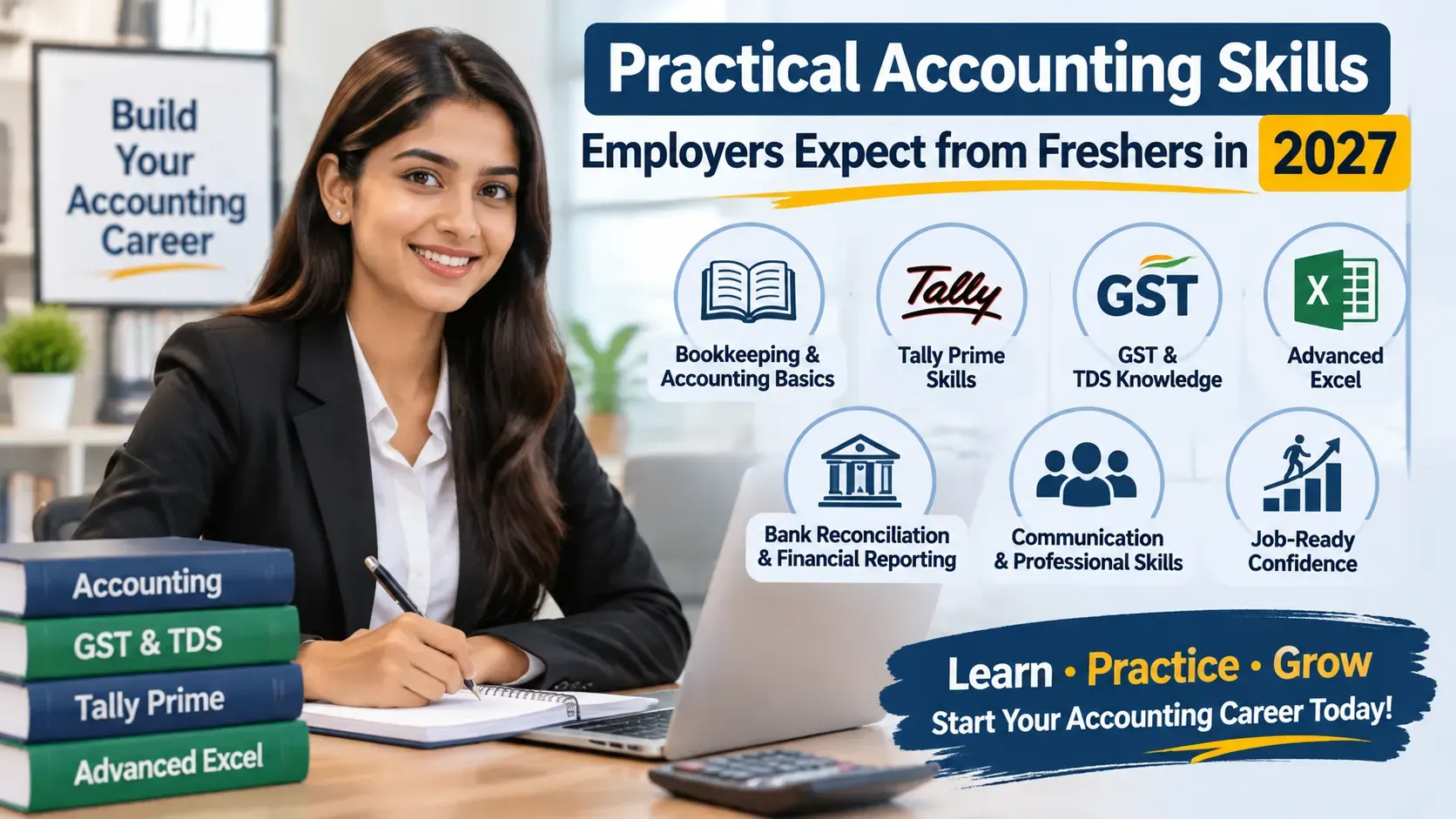
Getting into accounting takes more than just a degree or knowing the theory behind financial concepts. Today businesses want people who know how businesses do business, keep financial records, use accounting software and meet their daily compliance needs. The right practical accounting skills for students may make the entry-level accounting jobs easier for the B.Com graduates and aspiring professionals in 2027, boosting their confidence and making them ready for the jobs.
If you are looking to become an accountant, accounts executive, billing assistant or GST executive, practical knowledge can make a lot of difference. Employers want people that can apply accounting concepts to the real world, not just rattle off textbook definitions.
Why Do Freshers Need Practical Accounting Skills?
Accurate financial records should be present in every business, whether it is a small shop, a startup, or an established company. Accountants record income and expenditure, sales and purchases, payments and prepare financial reports.
If you are new to this, the most important thing to being a good accountant is knowing how these activities work in practice. They are looking for freshers who can maintain records, identify simple errors, file financial data and assist senior accountants in day-to-day activities.
Therefore when preparing for a career in accounting, a combination of theoretical knowledge, knowledge of accounting software and practical experience is so important.
Basic Bookkeeping and Accounting Skills
Accounting fundamentals are the basics of professional accounting work.Freshers must be aware of debit and credit rules, journal entries, ledger posting, trial balances and basic financial statements.
Besides these, the ability to maintain books is very important to keep accurate records of day to day business activities. An accounts professional may need to record sales, purchases, receipts, payments and balances due.
If a business buys office supplies or receives payment from a customer, the transaction must be recorded in the right account. The freshers will be able to keep their books in an orderly fashion and avoid common accounting mistakes if they know these entries.
These basic accounting skills are applicable in all kinds of industries, as every business requires keeping accurate records of their finances.
Tally Prime Skills and Knowledge in Accounting Software
Businesses now use accounting applications to process transactions, prepare invoices, maintain inventories and generate financial statements. So, knowing accounting software is one of the most valuable accountant job skills for freshers.
By learning Tally Prime, students can understand how accounting activities are performed in a business environment. Some of the important skills of Tally Prime are company creation, ledger management, sales and purchase voucher creation, receipt and payment creation, GST transactions and report generation.
Knowledge of other applications like Busy Accounting Software is also important as it is the business requirements on the basis of which they choose the software.
The real benefit is knowing how and why to record a transaction, not just where to click in the software.
GST Awareness for Accountants and TDS Basics
Basic taxation knowledge is essential for accounting professionals as businesses have to comply with applicable tax regulations. Freshers should be aware of how GST works, difference between CGST, SGST and IGST, requirements of GST invoice and purpose of returns like GSTR-1 and GSTR-3B.
Similarly, knowledge of Tax Deducted at Source (TDS) helps the candidates to know how the tax deductions get entered and reconciled. They should be aware of the fundamentals of TDS, deduction records and importance of correct reporting.
Practical GST and TDS training can help students learn about the connection of taxation with day-to-day accounting work. This information is very useful for the candidates who are looking for jobs like Accounts Assistant, GST Executive and Taxation Support.
Excel for Accountants – Advanced
Microsoft Excel is a popular application used to organize financial data, prepare reports and analyze business information. Hence, it becomes an important skill for freshers entering the finance and accounting field to know Advanced Excel for accountants.
Students should learn formulas like SUM, IF, SUMIF, COUNTIF and VLOOKUP or XLOOKUP. They should also know how to sort, filter, use conditional formatting and pivot tables .
For example, an accounts exec may use Excel to create monthly expense reports, analyze sales revenues, track payments due and manage client information. These skills help to minimize repetitive tasks and increase the accuracy of financial reporting.
Bank Reconciliation and Financial Reporting
With the help of financial reporting skills understanding, freshers learn to organize accounting information and present it in a useful format. They must be able to produce basic expense summaries, cash flow reports and statements of outstanding payments.
Another key responsibility involves reconciling bank accounts. This is done by comparing the company’s accounting records to its bank statement to find any missing transactions, bank charges, errors in entries, and differences in balances.
They help businesses maintain accurate records and monitor their financial status. A fresher can gain confidence in a professional work place by practicing them with sample business transactions.
Executive Qualities of Communication & Other Accounts
Technical know-how is not enough in itself to make a successful accounting professional. Employers also look for communication skills, accuracy, time management and problem-solving skills.
Accounts executives work with customers, suppliers, colleagues and management on a regular basis. They may have to ask for missing invoices, adjust for payment discrepancies, arrange documents or explain financial details.
Attention to detail is as important as a small error in an invoice or ledger entry can impact financial records. The freshers can do their work more efficiently by making a habit of cross-checking the calculations and verifying the transactions.
How can freshers build job-ready accounting skills?
The best way to develop job-ready accounting skills is to practice regularly. Students should practice journal entries, ledger, invoice preparation, GST transactions, TDS calculations, bank reconciliation and financial reporting.
Structured practical course in accounting can help you to learn bookkeeping, Tally Prime, GST, TDS and Advanced Excel under guided learning. It can also help the learner to see how these tools and concepts are actually used in business operations.
RBPerfect provides accounting and taxation training in Faridabad which helps you to gain practical knowledge and helps you to get entry level accounting jobs. If you opt for an accounting course for freshers that includes software practice and real-time examples, the learning will be more valuable.
Get Ready For Your Accounting Career In 2027
Employers look for freshers who can blend the fundamentals of accounting to the practical knowledge of software, awareness of taxation and professional communication. Candidates having good knowledge of bookkeeping, Tally Prime, GST, Advanced Excel, and financial reporting will be more efficient in managing their workplace duties.
These skills take practice to build, but the effort can build a stronger foundation for a career in accounting. Don’t just get the qualification, gain the confidence to carry out real business accounting tasks accurately and responsibly.